Virtual Reality has evolved into a medium capable of delivering genuinely immersive experiences, combining high-fidelity visuals with spatial audio that convincingly replicates real-world environments. Yet despite these advances, one sensory dimension remains conspicuously absent: olfaction. The lack of scent integration represents a significant gap in VR's quest for complete sensory immersion, as smell plays a fundamental role in how humans perceive and remember their surroundings.
A breakthrough from researchers at the Institute of Science Tokyo, working alongside Rakuten Mobile, may finally address this limitation. The team has engineered a wearable olfactory device capable of synthesizing up to eight distinct scents dynamically, delivering them in synchronization with virtual environments in real time.
How does it work?
Designed with form factor in mind, the apparatus is compact enough to be worn comfortably alongside standard VR headsets. The system analyzes the current virtual scene and algorithmically generates corresponding scents by mixing fragrance components in calculated proportions. Whether you're navigating a virtual coniferous forest or exploring a coastal marketplace, the device ensures your olfactory experience aligns with the visual narrative.
The engineering approach combines three key components: a precision microdispenser, an ultrasonic atomization system, and a miniaturized pump mechanism that regulates both dosage and timing of scent delivery. During validation testing, the research team deployed the device with virtual tourism content, enabling participants to experience location-specific aromas corresponding to their digital destinations.
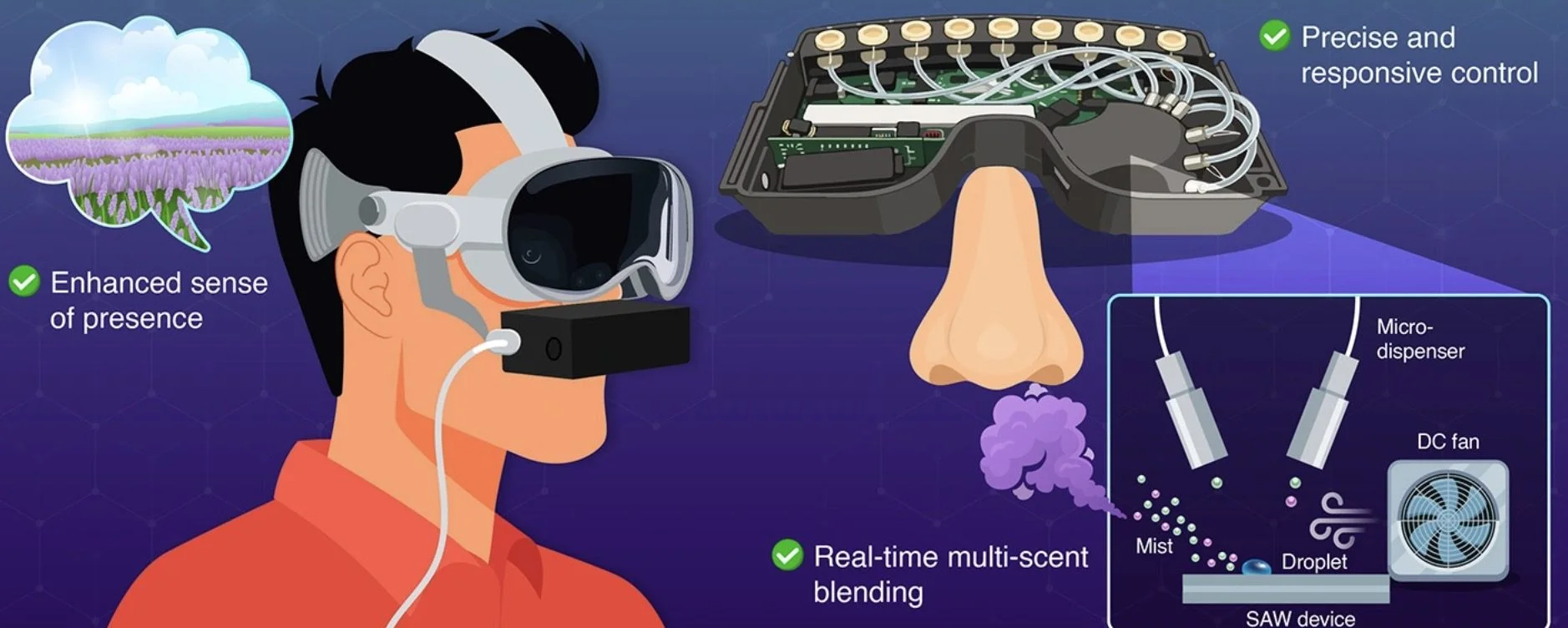
Professor Takamichi Nakamoto, who spearheaded the research initiative, articulated the project's objective: "We wanted to develop a system that could reproduce complex scents quickly during immersive virtual experiences."
The implementation achieves rapid scent delivery with equally efficient dissipation, avoiding the lingering fragrance accumulation that would compromise the experience. Test participants consistently reported enhanced presence and environmental realism when olfactory stimuli were integrated into their virtual sessions.
Can smelling VR worlds do more than entertain you?
The applications extend well beyond recreational use. While 4DX cinema experiences have already demonstrated scent's entertainment value, this technology opens doors to more substantive implementations. Professional training simulations could benefit from olfactory cues, while fragrance industry applications for product development and demonstration present clear commercial pathways. The connection between smell and memory also suggests therapeutic applications, particularly for elderly populations where scent-triggered recall can support cognitive engagement.
Following demonstrations at several international conferences, the device has generated considerable interest from industry observers. While the journey from research prototype to consumer product remains substantial, this development represents meaningful progress toward achieving truly multi-sensory virtual reality experiences.