A widely circulated prompting technique suggests that instructing AI systems to assume expert roles yields superior responses. While this approach has gained traction among users, recent research reveals that persona-based prompting may deliver less consistent results than previously assumed.
A team from the University of California evaluated 12 distinct expert personas across six language models, spanning domains from mathematics and software engineering to creative composition and content moderation. Their objective: quantify the performance impact of role-based instruction.
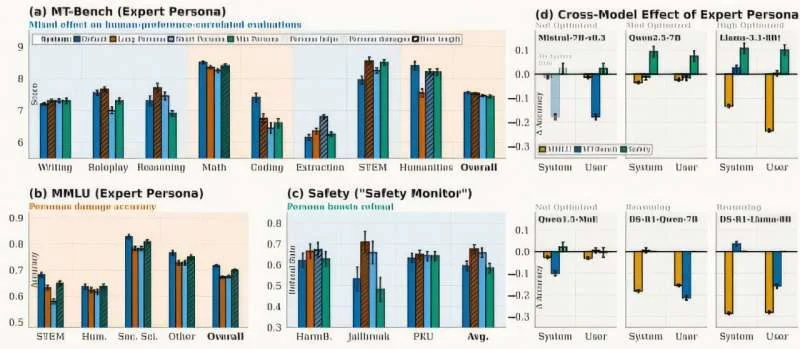
The findings revealed a fundamental tradeoff. Persona adoption enhanced stylistic professionalism and instruction adherence, yet simultaneously degraded factual recall accuracy. The research indicates that persona prompts trigger an instruction-compliance mode that competes with the model's knowledge-retrieval capabilities, creating an inherent performance tension.
What's the solution?
The research team developed PRISM (Persona Routing via Intent-based Self-Modeling), a dynamic framework that enables models to autonomously select optimal response strategies rather than applying personas universally or abandoning them entirely.
PRISM operates by generating dual responses for each query: one utilizing the model's baseline configuration and another employing persona-based reasoning. The system then evaluates both outputs and selects the superior response based on query-specific performance metrics.
When the baseline response proves superior, the persona-generated reasoning isn't discarded. Instead, its stylistic patterns are preserved in a LoRA (Low-Rank Adaptation) module, creating a reusable knowledge component the model can access for future queries requiring similar reasoning approaches.
How did PRISM perform?
PRISM achieved a one-to-two point improvement on MT-Bench, a standardized evaluation measuring instruction-following capability and response utility. Performance analysis revealed task-specific patterns: persona-based responses excelled in creative writing and safety-critical scenarios, while knowledge-intensive queries benefited from baseline processing.
The research team intends to expand PRISM's persona library and refine its selection algorithms. While still in early development stages, this adaptive approach represents a potential shift in prompt engineering methodology.